Buddhist Women on a Path of Spiritual Awakening
Not Equal and Not Less
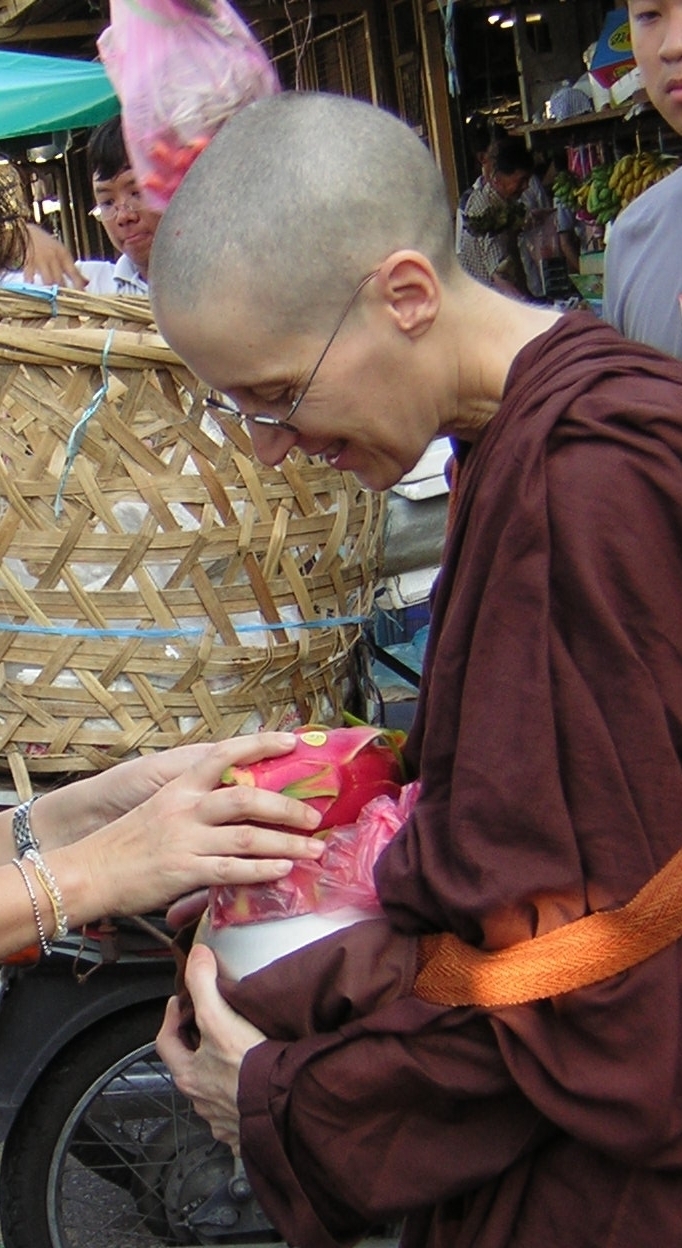 I first entered monastic life during a long period of retreat in Myanmar. It was March, 1988. Deeply inspired by the Dhamma teachings, I requested bhikkhunī ordination – the full-ordination for women established by the Buddha himself more than 2 1/2 millenia ago. But I was told that there was no living bhikkhunī lineage for Theravāda women. I had no idea that this training had vanished from the Theravāda tradition during the 4th century A.D.
Instead, I was given 10 precept ordination as a Theravāda alms mendicant since this was the highest training available for Theravādin women monastic aspirants. There was no glimmer of hope that I would ever be given full ordination in my lifetime. Little did I know.
This was my first contact with the disparity between the Theravāda Buddhist training for monks and nuns. Previously, I had only a vague notion about the inferior position of women in the Buddhist ecclesiastic order. During retreat in Myanmar, I diligently practised intensive meditation with a few other foreign students, guided by the abbot himself.
Among them was an American nun who had taken temporary precepts. When she was ready to disrobe, our teacher, Sayadaw* U Pandita, instructed her to recite the Five Precepts in front of a Buddha statue. This struck me as a lesser treatment in comparison to the ceremonial blessings given to monks who made the choice to return to lay life.
Troubled that my vows, so precious to me, carried little weight in the ecclesiastic order, I would soon discover that this was just the tip of a glacier. In the years to come, I encountered an entrenched culture of bias. According to the Theravāda scriptures, the Buddha himself had to be persuaded to ordain women, and predicted that their admission to the Order would lead to its premature decline. Historically, this has not materialized.
In fact, women have been disadvantaged. One translation of this scriptural text recounts an empathetic interchange between the Buddha and his aunt, Mahapajapati Gotami, who nursed him and became his surrogate mother when his own mother died in child birth. Mahapajapati arrived at the temple where the Blessed One was spending the Vassa accompanied by a royal retinue of ladies in waiting who shared her aspiration to enter the Buddha’s monastic order. But when they petitioned him, he asked them rather to remain at home within the sanctuary of the palace. This was due to his concern for their safety and well-being if they were to live as forest wanderers, vulnerable to harm from humans as well as animals.
The disappearance of Theravāda bhikkhunīs* in Sri Lanka over 1000 years ago further weakened the lineage of female monastics in a culture where women were viewed as inferior and incapable of the highest attainments. The Canonical texts also reference being a male as precondition for the attainment of Buddhahood. This would further eclipse core scriptural teachings about anatta, non-identification with physical characteristics of the body, a teaching meant to transcend social ideologies that classified beings according to gender and race. Such views compromised the understanding of the true Dhamma itself.
In the Buddha’s doctrine of redemption through individual effort, spiritual equality for all beings is a given. The discourses of enlightened bhikkhunīs who were the Buddha’s contemporaries, like the female Arahants Dhammadīnnā, Khemā, Patacarā, and many more, remind us that gender does not govern spiritual aptitude. Even so, for centuries now into our modern era, religious misogyny retains a residue of disdain for women monastics.
I experienced this while on pilgrimage in India early in this century with my supporter who had also shaved her head for the pilrgrimage. Late one night, we arrived in Kosinagar, one of the holiest places for Buddhists – where the Buddha himself was laid to rest. We were travelling on foot, carrying our luggage and weary when we reached the sprawling complex of a palatial Thai temple. It was off-season. Outside a row of darkened empty rooms, we met a resident monk who brusquely interrogated us.
I learned that he knew my preceptor and where I had trained. He examined my ordination certificate from Amaravati Monastery signed by Ajahn Sumedho who was well-respected here and had recently visited. Still, without so much as offering drinking water or a lamp to light our way back to the gate, he ushered us out to the deserted road side, refusing us shelter even for one night. This stung – as pilgrim daughters of the Buddha – to be rebuffed by an ordained monk in a Buddhist monastery and sent out at midnight in pitch darkness on a deserted rural road far from the nearest shelter.
We had no recourse but to walk the two kilometres back to the village in the dead of night. When we reached the gate of a Korean temple adorned by an enormous statue of Kuan Yin, goddess of compassion, we received the universal welcome to all travellers and visitors, irrespective of gender, religion, caste, or race. The gate was unlocked, no less!
Entering, we found a light still burning and were warmly welcomed by a young Bhikkhunī – no questions asked. She invited us to stay the night and a room was prepared. Our weariness and disenchantment melted in the kindness of the resident monastics. We stayed nearly a week.
On another occasion, I attended a memorial ceremony for a friend’s mother at a temple in Malaysia. Spotting me, the senior monk shouted to my host, “Female?” No greeting, just that. When I approached and knelt in front of him, he dismissed me coldly, directing me to sit with the lay women seated on the floor around the perimeter of the shrine area. Instread, I spoke up: “Venerable, I just want to pay respects to you,” and bowed three times in respect to his aspiration – regardless of his cutting words, and silently retreated to a space on the floor with the women gathered for the service.
It is hard to feel compassion for one clothed as a monastic who acts in ways unworthy of it. I may be junior in the hierarchy but I am not inferior. Disrespect is not an ethical way of conduct, but I reflected that such maltreatment could not diminish my aspiration to respond with compassion. To the contrary, these encounters were good tests of my faith in the Buddha’s way of purification and my refuge in the Noble Triple Gems.
I made a determination that – even in the face of shameless treatment – I would try to practice kindness and respect so I could reflect the heart of every true spiritual lineage. More than convention, it is our mandate – never to be ransomed to those who do less.
Sayadaw U Pandita once said he could not ordain me as a bhikkhunī but I could become a bhikkhu*. He clarified what he meant, saying that I was indeed worthy of the robe and I would be able to see the danger in samsāra*. Having left the home life, I am moved and encouraged by this loftier footing, and use it as my compass.
In every encounter, can I choose – at least try – to be wise, to respond in gentle and kind ways, compassionate to all – unequivocally? It’s the work of this lifetime – and the most worthy way.
*Sayadaw: Venerable Teacher (Burmese)
*Bhante: Venerable Sir
*bhikkhunī: fully ordained nun
*bhikkhū: fully ordained monk
*samsāra: the cycle of birth and death
© Ayyā Medhānandī 2026

~ Dhammapada Verse 54